Product Details:
Payment & Shipping Terms:
|
| Body Material: | Carbon Steel A216 WCB | Ball: | SS304, SS316, F51, F53 Etc. |
|---|---|---|---|
| Size: | 1/2in - 10in | Pressure Rating: | Class 150LB / 150# |
| Actuating Device: | Lever, Wrench, Gear Box | Connection Ends: | RF, FF |
| Seat: | Soft Seated, PTFE | OEM Service: | YES |
| Highlight: | manual ball valve,lockable ball valve |
||
| Model | 2-piece side-entry floating soft-seated ball valve |
|---|---|
| Design standard | API 6D / ASME B16.34 |
| Pressure class | ASME Class 150 / 150LB / 150# |
| Size range | 1/2"–10" |
| Body material | ASTM A216 WCB; A352 LCB / LCC and sour-service on request |
| Trim | ASTM A105 + hard chrome / ENP ball; A182 F6a stem; PTFE / RPTFE seat |
| Bore type | Full bore or reduced bore |
| Body style | 2-piece side-entry split body, floating ball |
| End connections | RF flanged (ASME B16.5); FF on request |
| Face-to-face / end-to-end | ASME B16.10 |
| Fire safety / anti-static | Fire-safe to API 607 / JB/T 6899 / BS 6755 Part 2; anti-static design |
| Actuator | Lever or worm gear; electric / pneumatic on request |
| Inspection & test | API 598 / API 6D |
| Sour service | NACE MR0175 / ISO 15156 on request |
This Class 150LB cast carbon steel floating soft-seated ball valve is the 2-piece side-entry design, ASTM A216 WCB, 1/2" to 10", RF flanged, full bore or reduced bore. In a floating ball valve, the ball is supported by the two seat rings and moves slightly downstream under pressure to seal against the downstream seat; this design is simple and economical, and is commonly used on small and medium sizes at low to medium pressure. The body and bonnet are ASTM A216 WCB; ball is ASTM A105 + hard chrome / ENP; stem is ASTM A182 F6a; seat is PTFE / RPTFE. The valve has an anti-blowout stem, an anti-static device, a fire-safe structure, a middle flange metal-to-metal leak-tight structure and a self-relieving seat. RF flanged ends are to ASME B16.5; FF is available on request; face-to-face is to ASME B16.10; testing is to API 598 / API 6D.
This WCB Class 150 2PC floating ball valve is specified on water, oil, gas and general utility service where a quarter-turn valve with bubble-tight shutoff is required at small and medium sizes. The WCB body is suitable for non-corrosive and mildly corrosive service; the full bore design gives the lowest pressure drop and allows pigging, while the reduced bore design gives a more compact and economical valve. For low-temperature service down to about -46°C, A352 LCB / LCC is available on request; for sour service, the anti-sulphur series and NACE MR0175 / ISO 15156 compliance are available on request.
Design and manufacture: API 6D and ASME B16.34.
Inspection and test: API 598 and API 6D.
End flange dimension: ASME B16.5.
BW end dimension (on request): ASME B16.25.
Face-to-face and end-to-end: ASME B16.10.
Pressure-temperature rating: ASME B16.34.
Fire safety: API 607, JB/T 6899 and BS 6755 Part 2.
Sour service: NACE MR0175 / ISO 15156 on request.
1. Product: 2-piece side-entry floating soft-seated ball valve
2. Design: API 6D / ASME B16.34
3. Face-to-face: ASME B16.10
4. Flange End: ASME B16.5
5. Size Range: 1/2"–10"
6. Pressure Rating: ASME Class 150 / 150#
7. Body Material: ASTM A216 WCB; A352 LCB / LCC and sour-service on request
8. Trim: ASTM A105 + hard chrome / ENP ball; A182 F6a stem; PTFE / RPTFE seat
9. Bore Type: Full bore or reduced bore
10. Actuator: Lever or worm gear; electric / pneumatic on request
WCB vs LCB / sour-service: ASTM A216 WCB is cast carbon steel for water, oil and gas service where corrosion is not severe. ASTM A352 LCB / LCC is low-temperature cast steel for service down to about -46°C. The sour-service (anti-sulphur) series uses sour-service bolting such as A193 B7M / A194 2HM and a suitable body material, and is intended for natural gas containing H2S and impurities. This page is centred on the WCB version; LCB and sour-service are available on request.
2PC vs 3PC: A 2-piece side-entry ball valve has the body split into two parts, usually the main body and one side end cap, bolted together. The ball, seats and seals are assembled from the side. This is compact and economical, and allows maintenance by removing the side cap. A 3-piece body has two end caps and allows the centre section to be removed without disturbing the pipe; a top-entry body allows maintenance from the top without removing the valve from the line. This page is the 2-piece side-entry design.
Full bore vs reduced bore: A full bore ball valve has a bore matching the pipe internal diameter, giving the lowest pressure drop and allowing pigging. A reduced bore valve has a smaller bore, giving a more compact and economical valve at the cost of a higher pressure drop. This series is available in both full bore and reduced bore; specify the bore type in the inquiry.
1. Switch Indication of Hand-Operated Floating Ball Valve
The moving parts of the valve body, ball, stem and handle are an assembly unit. The head of the valve stem is shaped as a double-flat, so it is easy to distinguish whether the valve is in the ON position or the OFF position from the handle position. When the handle or stem double-flat is parallel to the pipe axis, the valve is in the ON position; when the handle or stem double-flat is vertical to the pipe axis, the valve is in the OFF position.
2. Valve Locking Device
To prevent misoperation, the fully opened or closed position of the valve can be locked, especially when valves are mounted outdoors or when valves are not allowed to be opened or closed by the process. A lockhole locating tab is designed if requested by the user to meet the process requirements.
3. Anti-Blowout Structure of Valve Stem
When the medium passes through the valve, the pressure in the valve body may push the stem out; during repair, if there is pressure in the middle cavity, the stem or medium can blow out when the valve is disassembled, causing injury. To prevent this, a dummy plug is placed at the lower part of the stem. Even if there is a fire, or the packing and thrust bearing are burnt, or the packing is damaged, the medium pressure makes the dummy plug contact the upper seal face of the valve body, preventing medium leakage from the damaged packing position.
4. Anti-Static Device
When operating the valve, friction between the ball and the non-metal seat (such as PTFE) produces electrostatic charge that can accumulate on the ball. To prevent static spark, an anti-static device is placed on the valve to divert the electric charge accumulated on the ball through the static channel between the ball and the stem, or between the stem and the valve body.
5. Fire-Safe Structure
In case of fire, the non-metal packing or seat will be burnt, and considerable medium leakage may cause fire spread. The fire-safe structure prevents mass medium leakage: once the seat is burnt, the ball directly contacts the metal face on the valve body, preventing medium leakage from the burnt seat. The fire protection and anti-static design conform to API 607, JB/T 6899 and BS 6755 Part 2.
6. Middle Flange Leak-Tight Structure
The connection between the valve body and the left body is sealed by a gasket. To prevent seal leakage caused by fire, high temperature or vibration, the valve body and the left body are designed with metal-to-metal contact, forming a seal flange to ensure leak-tightness.
7. Self-Relieving Structure
In case of abnormal pressure rise in the middle cavity of the valve due to changes in pipeline pressure or medium temperature, automatic pressure relief of the valve seat can be effected under the pressure of the medium itself, ensuring the safety of the valve.
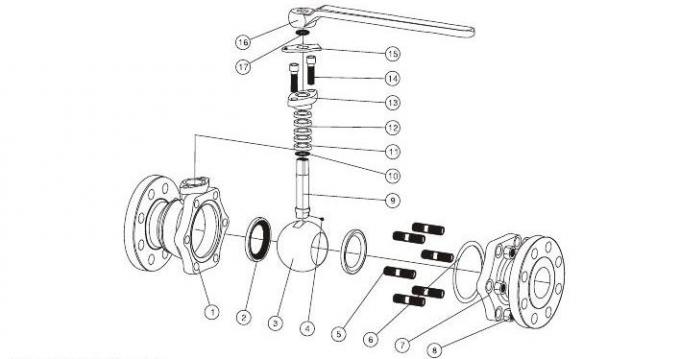
Swipe horizontally to see all materials
| No. | Part Name | Carbon Steel Series | Low-Temperature Series | Sour Service (Anti-Sulphur) |
|---|---|---|---|---|
| 1 | Body | ASTM A216 WCB | ASTM A352 LCB / LCC | ASTM A216 WCB |
| 2 | Seat | PTFE / RPTFE / braided graphite fibre / steel + rubber assembly | ||
| 3 | Ball | ASTM A105 + hard chrome / ENP | ASTM A352 LCB / LCC + ENP | ASTM A105 + hard chrome / ENP |
| 4 | Spring | Inconel X-750 | ||
| 5 | Stud | ASTM A193 B7 | ASTM A320 L7 | ASTM A193 B7M |
| 6 | Gasket | Flexible graphite + SS | ||
| 7 | Eyebolt nut | ASTM A194 2H | ASTM A194 4 | ASTM A194 2HM |
| 8 | Bonnet | ASTM A216 WCB | ASTM A352 LCB / LCC | ASTM A216 WCB |
| 9 | Stem | ASTM A182 F6a | ASTM A182 F6a | ASTM A182 F304 |
| 10 | Bush bearing | Metal + PTFE, braided graphite fibre | ||
| 11 | Packing seat | ASTM A182 F6a | ASTM A182 F6a | ASTM A182 F6a |
| 12 | Packing | Flexible graphite / PTFE | ||
| 13 | Nipple | ASTM A216 WCB | ASTM A351 CF8 | ASTM A216 WCB |
| 14 | Packing gland | ASTM A216 WCB | ASTM A351 CF8 | ASTM A216 WCB |
| 15 | Locating plate | ASTM A570 + Zn (Cr) | ||
| 16 | Circlip | AISI 1066 | ||
| 17 | Hand lever | ASTM A216 WCB | ||
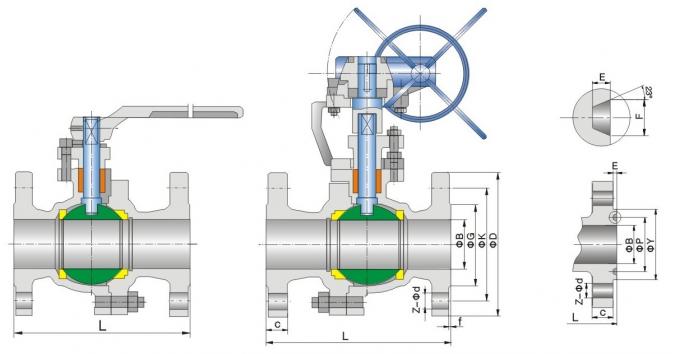
Swipe horizontally to see all dimensions
| Size | DN (mm) | L (RF) (mm) | B (mm) | D (mm) | G (mm) | f (mm) | K (mm) | z-Φd | C (mm) |
|---|---|---|---|---|---|---|---|---|---|
| 1" | 25 | 127 | 25 | 108 | 50.8 | 1.6 | 79.3 | 4-15.9 | 11.2 |
| 1 1/4" | 32 | 140 | 32 | 117 | 63.5 | 1.6 | 88.9 | 4-15.9 | 12.7 |
| 1 1/2" | 40 | 165 | 38 | 127 | 73.2 | 1.6 | 98.6 | 4-15.9 | 14.2 |
| 2" | 50 | 178 | 49 | 152 | 91.9 | 1.6 | 120.7 | 4-19.1 | 15.8 |
| 2 1/2" | 65 | 191 | 62 | 178 | 104.6 | 1.6 | 139.7 | 4-19.1 | 17.5 |
| 3" | 80 | 203 | 74 | 191 | 127 | 1.6 | 152.4 | 4-19.1 | 19.1 |
| 4" | 100 | 229 | 100 | 229 | 157.2 | 1.6 | 190.5 | 8-19.1 | 23.9 |
| 6" | 150 | 394 | 150 | 279 | 215.9 | 1.6 | 241.3 | 8-22.2 | 25.4 |
| 8" | 200 | 457 | 201 | 343 | 269.7 | 1.6 | 298.5 | 8-22.2 | 28.4 |
| 10" | 250 | 533 | 252 | 406 | 323.9 | 1.6 | 362 | 12-25.4 | 30.2 |
mm. Class 150 RF full bore shown; FF and reduced bore on request. 1/2" and 3/4" on request.
What does 2-piece side-entry split body mean on this WCB floating ball valve?
A 2-piece side-entry ball valve has the body split into two parts, usually the main body and one side end cap, bolted together. The ball, seats and seals are assembled from the side. This is compact and economical, and allows maintenance by removing the side cap. A 3-piece body has two end caps and allows the centre section to be removed without disturbing the pipe; a top-entry body allows maintenance from the top without removing the valve from the line. This page is the 2-piece side-entry design.
Should I specify full bore or reduced bore on this WCB Class 150 ball valve?
A full bore ball valve has a bore matching the pipe internal diameter, giving the lowest pressure drop and allowing pigging. A reduced bore valve has a smaller bore, giving a more compact and economical valve at the cost of a higher pressure drop. This series is available in both full bore and reduced bore; specify the bore type in the inquiry. For smaller sizes and lower pressure classes, reduced bore is often sufficient; for pigging or the lowest pressure drop, specify full bore.
What is the difference between WCB and LCB / sour-service on this floating ball valve?
ASTM A216 WCB is cast carbon steel for water, oil and gas service where corrosion is not severe. ASTM A352 LCB / LCC is low-temperature cast steel for service down to about -46°C. The sour-service (anti-sulphur) series uses sour-service bolting such as A193 B7M / A194 2HM and a suitable body material, and is intended for natural gas containing H2S and impurities. This page is centred on the WCB version; LCB and sour-service are available on request, and NACE MR0175 / ISO 15156 compliance is available on request.
Is this WCB 2PC floating ball valve fire-safe and anti-static?
Yes. The valve is designed with a fire-safe structure to API 607, JB/T 6899 and BS 6755 Part 2: if the soft seat ring is burnt in a fire, the ball directly contacts the metal face on the valve body, preventing mass leakage and limiting fire spreading. An anti-static device is fitted to divert the electrostatic charge generated by ball-to-seat friction through the static channel between the ball and stem, or between the stem and valve body. A locking device is optional at the fully open and closed positions. NACE MR0175 / ISO 15156 sour-service compliance is available on request.
Contact Person: Mr. Biff Teng
Tel: 86-18066318081


