Product Details:
Payment & Shipping Terms:
|
| Body Material: | Cast Stainless Steel A351 CF8M | Ball: | SS316, F51, F53 Etc. |
|---|---|---|---|
| Size: | 1/2in - 10in | Pressure Rating: | Class 150LB / 150# |
| Actuating Device: | Lever, Wrench, Gear Box | Connection Ends: | RF, FF |
| Seat: | Soft Seated, PTFE | OEM Service: | YES |
| Highlight: | manual ball valve,fire safe ball valve |
||
| Model | Floating soft-seated ball valve, RF flanged |
|---|---|
| Design standard | API 6D / ASME B16.34 |
| Pressure class | ASME Class 150 / 150LB / 150# |
| Size range | 1/2"–10" |
| Body material | ASTM A351 CF8M; CF8 / CF3 / CF3M available |
| Trim options | SS316, duplex stainless steel |
| Seat | PTFE / RPTFE |
| Bore type | Full port (full bore) |
| Body style | Floating ball, side-entry split body |
| End connections | RF flanged (ASME B16.5); FF on request |
| Face-to-face / end-to-end | ASME B16.10 |
| Fire safety / anti-static | Fire-safe to API 607 / JB/T 6899 / BS 6755 Part 2; anti-static design |
| Actuator | Lever or worm gear; electric / pneumatic on request |
| Inspection & test | API 598 / API 6D |
| Sour service | NACE MR0175 / ISO 15156 on request |
This Class 150LB cast stainless steel floating soft-seated ball valve is the CF8M design, full port, RF flanged, 1/2" to 10". Ball valves are durable, performing well after many cycles, and reliable, closing securely even after long periods of disuse; these qualities make them an excellent choice for shutoff and control applications, where they are often preferred to gate and globe valves, but they lack their fine control in throttling applications. The body is ASTM A351 CF8M; ball and stem are SS316 or duplex stainless steel; seat is PTFE / RPTFE. The valve has an anti-blowout stem, an anti-static device, a fire-safe structure, a middle flange metal-to-metal leak-tight structure and a self-relieving seat. RF flanged ends are to ASME B16.5; face-to-face is to ASME B16.10; testing is to API 598 / API 6D.
This CF8M Class 150 floating ball valve is specified on water, oil, gas, chemical, petrochemical, food and pharmaceutical service where a quarter-turn valve with bubble-tight shutoff is required at small and medium sizes and Class 150. The CF8M body gives good resistance to chloride pitting and crevice corrosion, and is suitable for seawater, brine and mildly corrosive service. The full port design gives the lowest pressure drop and allows pigging. RF flanged ends are the standard for ASME B16.5 joints; FF is available on request. For higher pressure classes or larger sizes, a trunnion ball valve should be specified instead.
Design and manufacture: API 6D and ASME B16.34.
Inspection and test: API 598 and API 6D.
End flange dimension: ASME B16.5.
BW end dimension (on request): ASME B16.25.
Face-to-face and end-to-end: ASME B16.10.
Pressure-temperature rating: ASME B16.34.
Fire safety: API 607, JB/T 6899 and BS 6755 Part 2.
Sour service: NACE MR0175 / ISO 15156 on request.
1. Product: Cast stainless steel CF8M floating soft-seated ball valve
2. Design: API 6D / ASME B16.34
3. Size Range: 1/2"–10"
4. Pressure Rating: ASME Class 150 / 150#
5. Body Material: ASTM A351 CF8M; CF8 / CF3 / CF3M available
6. Trim: SS316, duplex stainless steel; PTFE / RPTFE seat
7. Bore Type: Full port (full bore)
8. Actuator: Lever or worm gear; electric / pneumatic on request
9. Sour Service: NACE MR0175 / ISO 15156 on request
10. Inspection & Test: API 598 / API 6D
Floating vs trunnion: In a floating ball valve, the ball is supported by the two seat rings and moves slightly downstream under pressure to seal against the downstream seat. This design is simple and economical, and is commonly used on small and medium sizes at low to medium pressure, which is why this Class 150 CF8M series covers 1/2" to 10". In a trunnion ball valve, the ball is supported by top and bottom trunnion bearings, so the ball stays fixed and the seat rings are pushed against the ball; the trunnion design reduces operating torque and seat wear on large sizes and higher pressure classes.
RF vs FF: RF (raised face) is the standard flanged facing for Class 150 general service, with the gasket confined by the raised face. This page is the RF version to ASME B16.5. FF (flat face) is used where the mating flange is also flat face, typically on cast iron or plastic piping, or where the line specification requires a full-face gasket. The two facings are not interchangeable on the same joint; specify RF or FF in the inquiry.
CF8M vs CF8: ASTM A351 CF8 is the cast equivalent of 304 stainless steel, with 18–20% Cr and 8–12% Ni. ASTM A351 CF8M is the cast equivalent of 316 stainless steel, with 16–18% Cr, 10–14% Ni and 2–3% Mo. The molybdenum addition in CF8M gives better resistance to chloride pitting and crevice corrosion, and better resistance to reducing acids. CF8M is preferred for seawater, brine, chemical and petrochemical service where chlorides are present. This page is the CF8M version; CF8 / CF3 / CF3M are available on request.
1. Switch Indication of Hand-Operated Floating Ball Valve
The moving parts of the valve body, ball, stem and handle are an assembly unit. The head of the valve stem is shaped as a double-flat, so it is easy to distinguish whether the valve is in the ON position or the OFF position from the handle position. When the handle or stem double-flat is parallel to the pipe axis, the valve is in the ON position; when the handle or stem double-flat is vertical to the pipe axis, the valve is in the OFF position.
2. Valve Locking Device
To prevent misoperation, the fully opened or closed position of the valve can be locked, especially when valves are mounted outdoors or when valves are not allowed to be opened or closed by the process. A lockhole locating tab is designed if requested by the user to meet the process requirements.
3. Anti-Blowout Structure of Valve Stem
When the medium passes through the valve, the pressure in the valve body may push the stem out; during repair, if there is pressure in the middle cavity, the stem or medium can blow out when the valve is disassembled, causing injury. To prevent this, a dummy plug is placed at the lower part of the stem. Even if there is a fire, or the packing and thrust bearing are burnt, or the packing is damaged, the medium pressure makes the dummy plug contact the upper seal face of the valve body, preventing medium leakage from the damaged packing position.
4. Anti-Static Device
When operating the valve, friction between the ball and the non-metal seat (such as PTFE) produces electrostatic charge that can accumulate on the ball. To prevent static spark, an anti-static device is placed on the valve to divert the electric charge accumulated on the ball through the static channel between the ball and the stem, or between the stem and the valve body.
5. Fire-Safe Structure
In case of fire, the non-metal packing or seat will be burnt, and considerable medium leakage may cause fire spread. The fire-safe structure prevents mass medium leakage: once the seat is burnt, the ball directly contacts the metal face on the valve body, preventing medium leakage from the burnt seat. The fire protection and anti-static design conform to API 607, JB/T 6899 and BS 6755 Part 2.
6. Middle Flange Leak-Tight Structure
The connection between the valve body and the left body is sealed by a gasket. To prevent seal leakage caused by fire, high temperature or vibration, the valve body and the left body are designed with metal-to-metal contact, forming a seal flange to ensure leak-tightness.
7. Self-Relieving Structure
In case of abnormal pressure rise in the middle cavity of the valve due to changes in pipeline pressure or medium temperature, automatic pressure relief of the valve seat can be effected under the pressure of the medium itself, ensuring the safety of the valve.
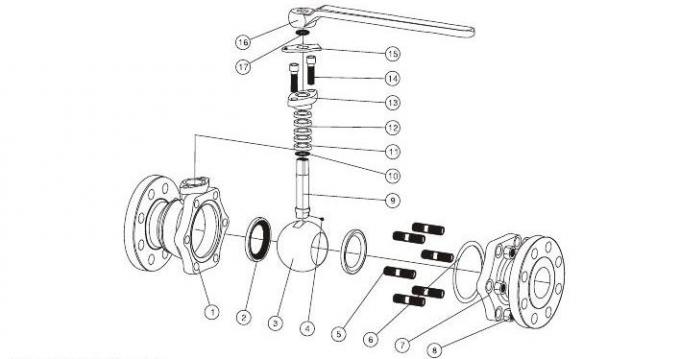
Swipe horizontally to see all materials
| No. | Part Name | Stainless Steel Series | Sour Service (Anti-Sulphur) |
|---|---|---|---|
| 1 | Body | ASTM A351 CF8 / CF8M / CF3 / CF3M | ASTM A351 CF8M |
| 2 | Seat | PTFE / RPTFE / braided graphite fibre / steel + rubber assembly | |
| 3 | Ball | ASTM A351 CF8 / CF8M / CF3 / CF3M | ASTM A351 CF8M + ENP |
| 4 | Spring | Inconel X-750 | |
| 5 | Stud | ASTM A193 B8 / B8M | ASTM A193 B8M |
| 6 | Gasket | Flexible graphite + SS | |
| 7 | Eyebolt nut | ASTM A194 8M | ASTM A194 8M |
| 8 | Bonnet | ASTM A351 CF8 / CF8M / CF3 / CF3M | ASTM A351 CF8M |
| 9 | Stem | ASTM A182 F304 / F316 | ASTM A182 F316 |
| 10 | Bush bearing | Metal + PTFE, braided graphite fibre | |
| 11 | Packing seat | SS304 / SS316 | |
| 12 | Packing | Flexible graphite / PTFE | |
| 13 | Nipple | ASTM A351 CF8 / CF8M | ASTM A351 CF8M |
| 14 | Gland packing | ASTM A193 B8 / B8M | ASTM A193 B8M |
| 15 | Locating plate | ASTM A570 + Zn (Cr) | |
| 16 | Circlip | AISI 1066 | |
| 17 | Hand lever | ASTM A216 WCB | |
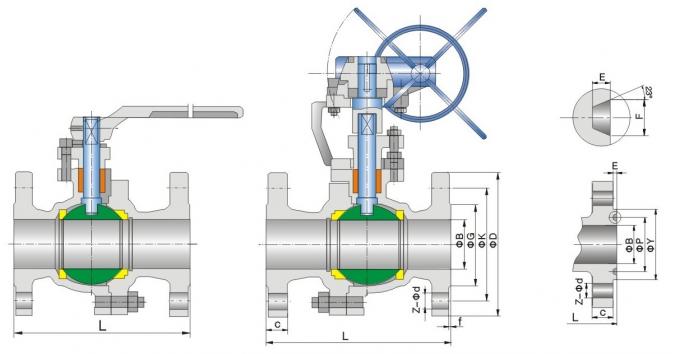
Swipe horizontally to see all dimensions
| Size | DN | L (RF) (mm) | B (mm) | D (mm) | G (mm) | f (mm) | K (mm) | z-Φd | C (mm) |
|---|---|---|---|---|---|---|---|---|---|
| 1" | 25 | 127 | 25 | 108 | 50.8 | 1.6 | 79.3 | 4-15.9 | 11.2 |
| 1 1/4" | 32 | 140 | 32 | 117 | 63.5 | 1.6 | 88.9 | 4-15.9 | 12.7 |
| 1 1/2" | 40 | 165 | 38 | 127 | 73.2 | 1.6 | 98.6 | 4-15.9 | 14.2 |
| 2" | 50 | 178 | 49 | 152 | 91.9 | 1.6 | 120.7 | 4-19.1 | 15.8 |
| 2 1/2" | 65 | 191 | 62 | 178 | 104.6 | 1.6 | 139.7 | 4-19.1 | 17.5 |
| 3" | 80 | 203 | 74 | 191 | 127 | 1.6 | 152.4 | 4-19.1 | 19.1 |
| 4" | 100 | 229 | 100 | 229 | 157.2 | 1.6 | 190.5 | 8-19.1 | 23.9 |
| 6" | 150 | 394 | 150 | 279 | 215.9 | 1.6 | 241.3 | 8-22.2 | 25.4 |
| 8" | 200 | 457 | 201 | 343 | 269.7 | 1.6 | 298.5 | 8-22.2 | 28.4 |
| 10" | 250 | 533 | 252 | 406 | 323.9 | 1.6 | 362 | 12-25.4 | 30.2 |
mm. Class 150 RF full port shown; FF on request.
What is the difference between floating and trunnion ball valves on this Class 150 CF8M valve?
In a floating ball valve, the ball is supported by the two seat rings and moves slightly downstream under pressure to seal against the downstream seat. This design is simple and economical, and is commonly used on small and medium sizes at low to medium pressure, which is why this Class 150 CF8M series covers 1/2" to 10". In a trunnion ball valve, the ball is supported by top and bottom trunnion bearings, so the ball stays fixed and the seat rings are pushed against the ball; the trunnion design reduces operating torque and seat wear on large sizes and higher pressure classes.
What does RF flanged mean, and is FF available on this CF8M ball valve?
RF (raised face) is the standard flanged facing for Class 150 general service, with the gasket confined by the raised face. This page is the RF version to ASME B16.5. FF (flat face) is available on request where the mating flange is also flat face, typically on cast iron or plastic piping, or where the line specification requires a full-face gasket. Specify RF or FF in the inquiry; the two facings are not interchangeable on the same joint.
What is the difference between CF8M and CF8 on this stainless steel ball valve?
ASTM A351 CF8 is the cast equivalent of 304 stainless steel, with 18–20% Cr and 8–12% Ni. ASTM A351 CF8M is the cast equivalent of 316 stainless steel, with 16–18% Cr, 10–14% Ni and 2–3% Mo. The molybdenum addition in CF8M gives better resistance to chloride pitting and crevice corrosion, and better resistance to reducing acids. CF8M is preferred for seawater, brine, chemical and petrochemical service where chlorides are present. This page is the CF8M version; CF8 / CF3 / CF3M are available on request.
Is this CF8M Class 150 floating ball valve fire-safe and anti-static?
Yes. The valve is designed with a fire-safe structure to API 607, JB/T 6899 and BS 6755 Part 2: if the soft seat ring is burnt in a fire, the ball directly contacts the metal face on the valve body, preventing mass leakage and limiting fire spreading. An anti-static device is fitted to divert the electrostatic charge generated by ball-to-seat friction through the static channel between the ball and stem, or between the stem and valve body. A locking device is optional at the fully open and closed positions. NACE MR0175 / ISO 15156 sour-service compliance is available on request.
Contact Person: Mr. Biff Teng
Tel: 86-18066318081


