Product Details:
Payment & Shipping Terms:
|
| Body Material: | Carbon Steel, Stainless Steel, Duplex Stainless Steel | Trim: | 13Cr, Half Stellite / Full Stellite, SS304, SS316, DSS |
|---|---|---|---|
| Size: | 2in - 36in | Pressure Rating: | Class 150LB - 2500LB |
| Actuator: | Automatically | Connection Ends: | RF, FF, RTJ, BW |
| Painting: | Standards | Other: | OEM Available |
| Highlight: | swing type check valve,cast steel swing check valve |
||
| Model | H44 (swing check valve, flanged) |
|---|---|
| Pressure range | ASME Class 150 – 2500 |
| Size range | NPS 2" – 24" (DN50 – DN600) |
| Design standard | BS 1868 / ASME B16.34 / API 6D |
| Body materials | ASTM A216 WCB · ASTM A351 CF8 (304) · ASTM A351 CF8M (316) |
| Disc type | Swing disc, metallic seating surfaces, HF hardfaced |
| Trim options (WCB) | Trim 1 (13Cr) · Trim 5 (STL) · Trim 8 (13Cr + STL) |
| Bonnet type | Bolted bonnet (Class 150–900) · Pressure seal bonnet (Class 1500–2500) |
| End connections | RF / RTJ (ASME B16.5) · BW (ASME B16.25) · SW (ASME B16.11) |
| Inspection & test | API 598 / API 6D |
| Special options | NACE MR0175 on request |
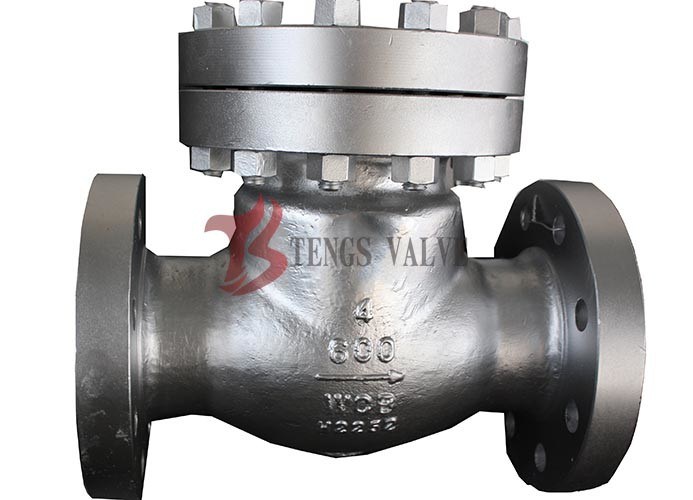
This H44 swing check valve is the API 6D / BS 1868 cast steel design with a swing disc and metal seating surfaces. The body-bonnet connection changes with pressure class: from Class 150 to Class 900 a bolted bonnet is used, with a spiral wound gasket at Class 150–600 and a metal ring gasket at Class 900; from Class 1500 to Class 2500 a pressure seal bonnet is used, in which the internal pressure tightens the seal. The body is available in ASTM A216 WCB, A351 CF8 (304) or A351 CF8M (316), with hardfaced seat and disc as Trim 1 (13Cr), Trim 5 (STL) or Trim 8 (13Cr + STL). End connections include RF and RTJ flanges to ASME B16.5, butt-weld to ASME B16.25 and socket-weld to ASME B16.11. Sizes run from NPS 2" to NPS 24".
This H44 swing check valve is used for reverse-flow protection in oil and gas, petrochemical, power generation, water treatment and general utility service. The swing disc provides low pressure drop and full-bore flow, and the metal seat with hardfacing resists erosion and wear at high differential pressure. For sour service the valve can be supplied to NACE MR0175 / ISO 15156 on request.
Design and manufacture: Cast steel check valve according to BS 1868, ASME B16.34 and API 6D; forged steel check valve according to API 602.
Inspection and test: API 598 or API 6D.
End flange dimension: ASME B16.5 (for NPS ≤ 24); ASME B16.47 series B, API 605 or ASME B16.47 series A / MSS SP-44 (for NPS > 24).
BW end dimension: ASME B16.25.
Socket-weld dimension: ASME B16.11.
Face to face and end to end: ASME B16.10.
Pressure-temperature ratings: ASME B16.34.
Shell wall thickness: API 600 and BS 1868.
1. Type: Swing check valve, cast steel
2. Model: H44
3. Bonnet type: Bolted bonnet (Class 150–900) / Pressure seal bonnet (Class 1500–2500)
4. Disc type: Swing disc
5. Size Range: 2" to 24" (DN50 to DN600)
6. Pressure Ratings: ASME Class 150 to 2500
7. End Connections: Flanged (RF, RTJ), butt-weld (BW), socket-weld (SW)
8. Materials: Cast steel in WCB, LCB, CF8, CF8M, CF3, CF3M, WC6, WC9, C5, C12, 4A, 5A or equivalent
9. Various trim materials available to suit service conditions
10. NACE MR0175 on request
H44 model interpretation: H44 is a Chinese national standard model designation for a flanged swing check valve. H denotes check valve, 4 denotes the flange connection, and the second 4 denotes the swing disc structure. The material of the sealing surface is indicated by a suffix letter: H44H for a hard-faced (13Cr or Stellite) seat, H44W for a stainless steel seat, H44Y for a carbide seat, and so on. The same valve is referred to internationally as an API 6D or BS 1868 swing check valve, and the H44 designation is normally quoted alongside the API or BS standard to avoid ambiguity.
Bolted bonnet vs pressure seal bonnet: from Class 150 to Class 900 a bolted bonnet is the standard construction — the bonnet is held to the body by studs and nuts, and the cover gasket is a spiral wound gasket at Class 150–600 and a metal ring gasket at Class 900. From Class 1500 to Class 2500 a pressure seal bonnet is used instead — the internal pressure acts on a sealing ring between the bonnet and the body, so the higher the pressure, the tighter the seal. The bolted bonnet is simpler and easier to disassemble; the pressure seal bonnet is used at the higher classes where the bolt load required by a bolted design would be impractical.
Cover gasket and seat design: the gasket and seat construction change with pressure class and size. Class 150/300 use a stainless steel + flexible graphite spiral wound gasket; Class 600 uses the same gasket with an optional metal gasket; Class 900 uses a metal ring gasket; Class 1500–2500 use the pressure seal design. On the seat side, carbon steel valves use a forged seat ring with optional hardfacing; a renewable threaded seat is used for NPS ≤ 10, while a welded seat is used for NPS ≥ 12; stainless steel valves typically use an integral seat, with threaded or welded types optional.
1. General
Bolted bonnet / pressure seal bonnet;
Swing and lift disc;
Metallic seating surfaces.
2. Body and Bonnet Connection
Class 150 to Class 900 check valves are usually bolted bonnet.
Class 1500 to Class 2500 check valves are usually pressure seal bonnet design.
3. Cover Gasket Style
Stainless steel + flexible graphite wound gasket is used for Class 150 and Class 300 check valve;
Stainless steel + flexible graphite wound gasket is used for Class 600 check valve, and a metal gasket is also optional for Class 600 check valve;
The metal ring gasket is used for Class 900 check valve;
The pressure seal bonnet design is used for Class 1500 to Class 2500 check valve.
4. Seat
For carbon steel check valve, the seat is usually forged steel. The seat sealing surface may be spray-welded with hard alloy if specified by the customer. A renewable threaded seat is used for NPS ≤ 10 check valves, and a welded type seat can also be optional if requested by the customer. A welded type seat is used for NPS ≥ 12 carbon steel check valves. For stainless steel check valve, an integral seat is usually adopted, or it can be machined integrally after hard alloy welding. Threaded or welded type seat is also optional for stainless steel check valve if requested by the customer.
Swipe horizontally to see all materials
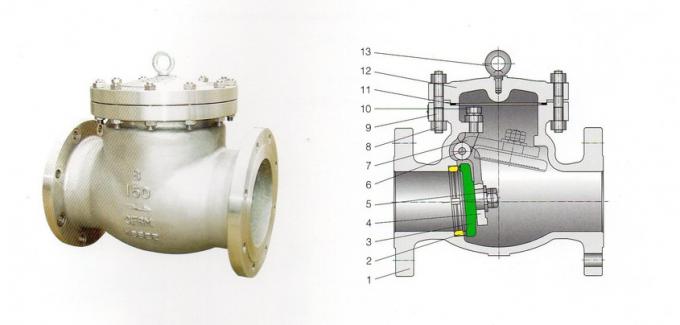
| Parts No. | Parts Name | WCB / Trim 1 | WCB / Trim 5 | WCB / Trim 8 | CF8 / 304 | CF8M / 316 |
|---|---|---|---|---|---|---|
| 1 | Body | ASTM A216 WCB | ASTM A216 WCB | ASTM A216 WCB | ASTM A351 CF8 | ASTM A351 CF8M |
| 2 | Seat Ring | A105 + 13Cr | A105 + STL | A105 + STL | ASTM A351 CF8 | ASTM A351 CF8M |
| 3 | Disc | ASTM A216 WCB + 13Cr | ASTM A216 WCB + STL | ASTM A216 WCB + 13Cr | ASTM A351 CF8 | ASTM A351 CF8M |
| 4 | Arm | ASTM A216 WCB | ASTM A216 WCB | ASTM A216 WCB | ASTM A351 CF8 | ASTM A351 CF8M |
| 5 | Nut | ASTM A194 2H | ASTM A194 2H | ASTM A194 2H | ASTM A194 8 | ASTM A194 8M |
| 6 | Arm Pin | ASTM A182 F6a | ASTM A182 F6a | ASTM A182 F6a | ASTM A182 F304 | ASTM A182 F316 |
| 7 | Yoke | ASTM A216 WCB | ASTM A216 WCB | ASTM A216 WCB | ASTM A351 CF8 | ASTM A351 CF8M |
| 8 | Bonnet Nut | ASTM A194 2H | ASTM A194 2H | ASTM A194 2H | ASTM A194 8 | ASTM A194 8M |
| 9 | Bonnet Bolt | ASTM A193 B7 | ASTM A193 B7 | ASTM A193 B7 | ASTM A193 B8 | ASTM A193 B8M |
| 10 | Bolt | ASTM A193 B7 | ASTM A193 B7 | ASTM A193 B7 | ASTM A193 B8 | ASTM A193 B8M |
| 11 | Gasket | 304SS + Graphite | 304SS + Graphite | 304SS + Graphite | 304SS + Graphite | 316SS + Graphite |
| 12 | Bonnet | ASTM A216 WCB | ASTM A216 WCB | ASTM A216 WCB | ASTM A351 CF8 | ASTM A351 CF8M |
| 13 | Eye Bolt | ASTM A181 | ASTM A181 | ASTM A181 | ASTM A181 | ASTM A181 |
Parts No. 1 Body: original source had "ASTM A216WCB" — corrected to "ASTM A216 WCB". Parts No. 3 Disc: original source had "ASTMA216WCB+13Cr" — corrected to "ASTM A216 WCB + 13Cr". Parts No. 8 Bonnet Nut (CF8 column): original source had "ASTM A1948" — corrected to "ASTM A194 8". Parts No. 9: original source had "Bon net bolt" — corrected to "Bonnet Bolt". Eye Bolt is listed as ASTM A181 in all five columns, as in the original; confirm against the material certificate — eyebolts are often supplied in A36 or A193 B7.
What does the H44 model designation mean on a swing check valve?
H44 is a Chinese national standard model designation for a flanged swing check valve. H denotes check valve, 4 denotes the flange connection, and the second 4 denotes the swing disc structure. The material of the sealing surface is indicated by a suffix letter: H44H for a hard-faced (13Cr or Stellite) seat, H44W for a stainless steel seat, H44Y for a carbide seat, and so on. The same valve is referred to internationally as an API 6D or BS 1868 swing check valve, and the H44 designation is normally quoted alongside the API or BS standard to avoid ambiguity.
When is a pressure seal bonnet used instead of a bolted bonnet on a check valve?
From Class 150 to Class 900, a bolted bonnet is the standard construction: the bonnet is held to the body by studs and nuts, and the cover gasket is a spiral wound gasket for Class 150–600 and a metal ring gasket for Class 900. From Class 1500 to Class 2500, a pressure seal bonnet is used instead: the internal pressure acts on a sealing ring between the bonnet and the body, so the higher the pressure, the tighter the seal. The bolted bonnet is simpler and easier to disassemble; the pressure seal bonnet is used at the higher classes where the bolt load required by a bolted design would be impractical.
What is the difference between a swing check valve and a lift check valve?
A swing check valve uses a disc hinged on a pin; the disc swings open under forward flow and closes under reverse flow. It is the standard choice for horizontal or vertical lines where low pressure drop and full-bore flow are required. A lift check valve uses a disc that lifts vertically off the seat and closes by gravity or spring; it is more compact but produces a higher pressure drop. H44 is a swing check valve; H41 and similar designations are used for lift check valves. Both are available in the check valve range, and the correct type depends on line size, flow rate and allowable pressure drop.
Is NACE MR0175 available on this H44 swing check valve?
Yes, NACE MR0175 / ISO 15156 compliance is available on request. The H2S partial pressure, operating temperature, CO2 content and chloride concentration from your line conditions are needed to confirm the correct material and hardness specification before production. For sour service at Class 900 and above, RTJ ends are typically specified together with NACE compliance.
Contact Person: Mr. Biff Teng
Tel: 86-18066318081