Product Details:
Payment & Shipping Terms:
|
| Body Material: | Stainless Steel A351 CF8 / CF8M / CF3 / CF3M | Trim: | SS304, SS316, DSS |
|---|---|---|---|
| Size: | 2in - 36in | Pressure Rating: | Class 150LB - 2500LB |
| Actuator: | Automatically | Connection Ends: | RF, FF, RTJ, BW |
| Disc Type: | Swing Type | Other: | OEM Available |
| Highlight: | swing type check valve,non return valve swing type |
||
| Model | H44W (stainless steel swing check valve, flanged) |
|---|---|
| Pressure class | ASME Class 150 – 2500 |
| Size range | NPS 2" – 36" (DN50 – DN900) |
| Design standard | BS 1868 / ASME B16.34 / API 6D |
| Body material | ASTM A351 CF8 (304) · A351 CF8M (316); CF3, CF3M, A890 4A / 5A on request |
| Trim options | Integral CF8 / CF8M seat; hardfaced seat optional |
| Bonnet type | Bolted bonnet (150–900); pressure seal bonnet (1500–2500) |
| Cover gasket | Spiral wound (150–600); metal ring gasket (900); pressure seal (1500–2500) |
| Disc type | Swing disc, metallic seating surfaces |
| End connections | Flanged ASME B16.5 / B16.47; butt-weld ASME B16.25 |
| Inspection & test | API 598 / API 6D |
| Special options | NACE MR0175 on request |
This stainless steel swing check valve is the H44W bolted bonnet design with a swing disc and metallic seating surfaces, covering Class 150 to Class 2500 in NPS 2" to 36". The body is ASTM A351 CF8 (304) or A351 CF8M (316) cast stainless steel; CF3, CF3M, A890 4A and 5A are available on request. The seat is integral to the stainless body, with a hardfaced seat option for high differential pressure. Flanged ends are to ASME B16.5 for NPS ≤ 24 and ASME B16.47 for NPS > 24; butt-weld ends are to ASME B16.25. The valve is API 598 / API 6D tested and is specified for corrosive, food-grade, pharmaceutical, marine and chloride-bearing service where carbon steel would corrode or contaminate the fluid.
This stainless steel swing check valve is specified on chemical and petrochemical process lines, food-grade and pharmaceutical piping, desalination and marine systems, offshore utility lines, and chloride-bearing or mildly corrosive service where a carbon steel body would rust or contaminate the fluid. CF8 (304) covers mildly corrosive, food-grade and general stainless service; CF8M (316) covers chloride-bearing, marine and chemical service where the molybdenum addition gives better pitting and crevice corrosion resistance. The swing disc gives low pressure drop in the forward direction, and the integral stainless seat avoids a separate hardfaced seat ring. For sour service the valve can be supplied to NACE MR0175 / ISO 15156 on request, normally in CF8M.
Design and manufacture: Cast steel check valve according to BS 1868, ASME B16.34 and API 6D; forged steel check valve according to API 602.
Inspection and test: API 598 or API 6D.
End flange dimension: ASME B16.5 (for NPS ≤ 24); ASME B16.47 series B, API 605 or ASME B16.47 series A / MSS SP-44 (for NPS > 24).
BW end dimension: ASME B16.25.
Socket-weld end (on request): ASME B16.11.
Face to face and end to end: ASME B16.10.
Pressure-temperature ratings: ASME B16.34.
Shell wall thickness: API 600 and BS 1868.
1. Type: Swing check valve, stainless steel
2. Design: Bolted bonnet (150–900); pressure seal bonnet (1500–2500)
3. Size Range: 2" to 36" (DN50 to DN900)
4. Pressure Rating: ASME Class 150 – 2500
5. End Connections: Flanged (ASME B16.5 / B16.47), butt-weld (ASME B16.25)
6. Body Material: ASTM A351 CF8 (304), A351 CF8M (316); CF3, CF3M, A890 4A / 5A on request
7. Various trim materials available to suit service conditions; integral or hardfaced seat
8. NACE MR0175 on request
9. Test and inspection: API 598 / API 6D
H44W vs H44H: H44W and H44H are both flanged swing check valves; the letter after H44 identifies the body and seating material. H44W is the stainless steel version, with an ASTM A351 CF8 or CF8M body and an integral stainless steel seat, used for corrosive, food-grade, pharmaceutical and chloride-bearing service. H44H is the carbon steel version, with an ASTM A216 WCB body and a 13Cr or STL hardfaced seat, used for non-corrosive water, oil and gas service. The two are not interchangeable on the same line: H44W is selected where the fluid would corrode or contaminate carbon steel.
CF8 vs CF8M: CF8 (ASTM A351 304) is specified for mildly corrosive media, food-grade and pharmaceutical service, and general stainless piping where chlorides are low. CF8M (ASTM A351 316) adds molybdenum and is specified for chloride-bearing, marine and chemical service where 304 would be susceptible to pitting and crevice corrosion. As a rule of thumb, CF8 is used where the chloride concentration is low and the fluid is not strongly reducing; CF8M is used for seawater, brine, chloride-containing chemicals and most refinery and petrochemical stainless service.
Bonnet type by class: Class 150 to Class 900 stainless steel swing check valves are normally supplied with a bolted bonnet: at these classes the bolt load needed to hold the bonnet against the internal pressure is manageable, and the bonnet can be removed for inline inspection of the disc, arm and seat. From Class 1500 upward the bolt load of a bolted bonnet becomes impractically large, so a pressure seal bonnet is used instead: internal pressure energises the bonnet seal, and the higher the pressure the tighter the seal. The cover gasket also changes with class: spiral wound for Class 150–600, metal ring gasket for Class 900, and pressure seal design for Class 1500–2500.
1. General
Bolted bonnet (150–900); pressure seal bonnet (1500–2500);
Swing disc;
Metallic seating surfaces.
2. Body and Bonnet Connection
Class 150 – Class 900 check valves are usually bolted bonnet. Class 1500 – Class 2500 check valves are usually pressure seal bonnet design.
3. Cover Gasket Style
Stainless steel + flexible graphite wound gasket is used for Class 150 and Class 300 check valve;
Stainless steel + flexible graphite wound gasket is used for Class 600 check valve, and metal gasket is also optional for Class 600 check valve;
Metal ring gasket is used for Class 900 check valve;
Pressure seal bonnet design is used for Class 1500 – Class 2500 check valve.
4. Seat
For stainless steel check valve, an integral seat is usually adopted, or it can be machined integrally after hard alloy welding. The threaded or welded type seat is also optional for stainless steel check valve if requested by the customer.
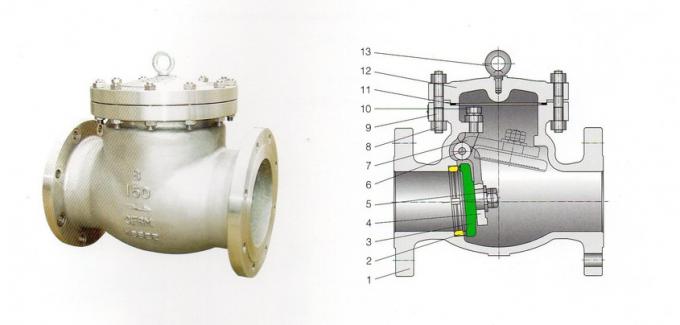
Swipe horizontally to see all materials
| Parts No. | Parts Name | CF8 / 304 | CF8M / 316 |
|---|---|---|---|
| 1 | Body | ASTM A351 CF8 | ASTM A351 CF8M |
| 2 | Seat Ring | ASTM A351 CF8 | ASTM A351 CF8M |
| 3 | Disc | ASTM A351 CF8 | ASTM A351 CF8M |
| 4 | Arm | ASTM A351 CF8 | ASTM A351 CF8M |
| 5 | Nut | ASTM A194 8 | ASTM A194 8M |
| 6 | Arm Pin | ASTM A182 F304 | ASTM A182 F316 |
| 7 | Yoke | ASTM A351 CF8 | ASTM A351 CF8M |
| 8 | Bonnet Nut | ASTM A194 8 | ASTM A194 8M |
| 9 | Bonnet Bolt | ASTM A193 B8 | ASTM A193 B8M |
| 10 | Bolt | ASTM A193 B8 | ASTM A193 B8M |
| 11 | Gasket | 304SS + Graphite | 316SS + Graphite |
| 12 | Bonnet | ASTM A351 CF8 | ASTM A351 CF8M |
| 13 | Eye Bolt | ASTM A181 | ASTM A181 |
Seat Ring and Disc are shown in the body material because stainless steel bodies use an integral seat; a hardfaced seat is available on request. The Gasket row shows the spiral wound gasket used for Class 150–600; Class 900 uses a metal ring gasket and Class 1500–2500 uses the pressure seal design. Eye Bolt is listed as ASTM A181 as in the original; confirm against the material certificate.
Swipe horizontally to see all values
| Nominal Pressure (LB) | Shell Test (MPa) | Water Seal Test (MPa) | Air Seal Test (MPa) |
|---|---|---|---|
| 150 | 3.00 | 2.20 | 0.5 – 0.7 |
| 300 | 7.50 | 5.50 | |
| 600 | 16.50 | 12.10 | |
| 900 | 22.50 | 16.50 | |
| 1500 | 37.50 | 27.50 | |
| 2500 | 63.00 | 46.20 |
Hydro test values in MPa per API 598. Shell test at 1.5* the 100°F rating; water seal test at 1.1* the 100°F rating; air seal test at 0.5–0.7 MPa. Air seal test is normally specified for Class 150–600; confirm the test requirements against the purchase specification.
What is the difference between H44W and H44H swing check valves?
H44W and H44H are both flanged swing check valves; the letter after H44 identifies the body and seating material. H44W is the stainless steel version, with an ASTM A351 CF8 or CF8M body and an integral stainless steel seat, used for corrosive, food-grade, pharmaceutical and chloride-bearing service. H44H is the carbon steel version, with an ASTM A216 WCB body and a 13Cr or STL hardfaced seat, used for non-corrosive water, oil and gas service. The two are not interchangeable on the same line: H44W is selected where the fluid would corrode or contaminate carbon steel.
When should I choose CF8 (304) and when CF8M (316) for this stainless steel swing check valve?
CF8 (ASTM A351 304) is specified for mildly corrosive media, food-grade and pharmaceutical service, and general stainless piping where chlorides are low. CF8M (ASTM A351 316) adds molybdenum and is specified for chloride-bearing, marine and chemical service where 304 would be susceptible to pitting and crevice corrosion. As a rule of thumb, CF8 is used where the chloride concentration is low and the fluid is not strongly reducing; CF8M is used for seawater, brine, chloride-containing chemicals and most refinery and petrochemical stainless service.
Why does the bonnet type change between Class 900 and Class 1500 on this valve?
Class 150 to Class 900 stainless steel swing check valves are normally supplied with a bolted bonnet: at these classes the bolt load needed to hold the bonnet against the internal pressure is manageable, and the bonnet can be removed for inline inspection of the disc, arm and seat. From Class 1500 upward the bolt load of a bolted bonnet becomes impractically large, so a pressure seal bonnet is used instead: internal pressure energises the bonnet seal, and the higher the pressure the tighter the seal. The cover gasket also changes with class: spiral wound for Class 150–600, metal ring gasket for Class 900, and pressure seal design for Class 1500–2500.
Is NACE MR0175 available on this stainless steel swing check valve?
Yes, NACE MR0175 / ISO 15156 compliance is available on request. CF8M is the usual body choice for sour service because its molybdenum content gives better resistance to sulphide stress cracking than CF8. The H2S partial pressure, operating temperature, CO2 content and chloride concentration from your line conditions are needed to confirm the correct material and hardness specification before production.
Contact Person: Mr. Biff Teng
Tel: 86-18066318081


