Product Details:
Payment & Shipping Terms:
|
| Body Material: | A105N | Trim: | 13Cr, Half Stellite / Full Stellite |
|---|---|---|---|
| Size: | 1/2in - 2in | Pressure Rating: | Class 800LB / 800# |
| Actuator: | Automatically | Connection Ends: | SW (Socket Weld) |
| Disc Type: | Lift Type | Other: | OEM Available |
| Valve type | Forged steel lift check valve |
|---|---|
| Body material | ASTM A105N; LF2 / F11 / F304 / F316 / F51 / F20 available |
| Pressure class | ASME Class 800 |
| Size range | 1/2"–2" |
| End connection | SW socket weld to ASME B16.11 |
| Construction | OS&Y; bolted bonnet / welded bonnet / pressure seal bonnet |
| Bore type | Full port / reduced port |
| Disc type | Lift (standard); swing and ball available |
| Seat | Metallic seating surfaces; integral or hard-alloy weld overlay |
| Cover gasket | SS + flexible graphite wound gasket; metal gasket; metal ring gasket; pressure seal design |
| Design standard | API 602 / BS 5352 |
| Inspection & test | API 598 |
| Special | NACE MR0175 on request |
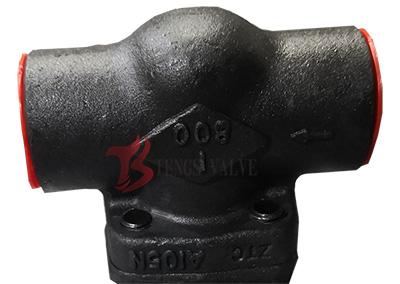
This forged steel lift check valve is supplied in ASTM A105N carbon steel as standard, with LF2, F11, F304(L), F316(L), F51 and F20 available, and covers ASME Class 800 in 1/2" to 2". The body and bonnet are forged, with OS&Y construction and a choice of bolted, welded or pressure seal bonnet. Full port and reduced port are both available. The lift disc opens vertically off the seat under forward flow and closes by gravity and back-pressure when flow stops or reverses, so the valve responds quickly and is suited to small-bore high-pressure piping and vertical upward-flow lines. Seating is metallic — integral with the body, or machined after hard-alloy weld overlay (410HF or Stellite as specified). The cover gasket is stainless steel + flexible graphite wound, with metal gasket, metal ring gasket or pressure seal design available. End connections are SW socket weld to ASME B16.11. Design is to API 602 / BS 5352, inspection and test to API 598, and NACE MR0175 can be supplied on request.
This forged A105N lift check valve is used for non-return protection in small-bore high-pressure piping — water, steam, oil and gas lines, boiler feed and drain lines, auxiliary piping on power and process plants, and other Class 800 small-bore services where a compact check valve with fast closing is required. A105N carbon steel is the economical choice for non-corrosive media at moderate temperature; LF2 covers low-temperature service, F11 chrome-moly covers elevated temperature, F304 / F316 stainless covers corrosive media, F51 duplex covers chloride-bearing service, and F20 covers nickel-alloy duty. For sour service, NACE MR0175 can be specified. The lift disc design is suited to vertical upward-flow lines and to installations where a short stroke and quick response are preferred over the lower pressure drop of a swing check.
Design and manufacture: API 602, BS 5352.
SW socket weld dimension: ASME B16.11.
Screw thread dimension: ASME B1.20.1.
Butt-welding dimension: ASME B16.25.
Flange end dimension: ASME B16.5.
Inspection and test: API 598.
Material: ASTM / ASME A105N, LF2, F11, F304(L), F316(L), F51, F20.
Special: NACE MR0175 / ISO 15156 on request.
1. Construction: OS&Y; bolted bonnet / welded bonnet / pressure seal bonnet
2. Bore type: Full port / reduced port
3. Size range: 1/2"–2"
4. Pressure rating: ASME Class 800
5. End connection: SW socket weld to ASME B16.11
6. Body material: ASTM A105N; LF2 / F11 / F304(L) / F316(L) / F51 / F20 available
7. Disc type: Lift; swing and ball available
8. Trim: Various trim materials to suit service conditions
9. Special: NACE MR0175 on request
10. Seat: Metallic seating surfaces — integral or hard-alloy weld overlay
Lift vs swing vs ball check: A lift check valve uses a disc that lifts vertically off the seat and closes by gravity and back-pressure; the stroke is short, the response is quick, and the valve is compact, which suits small-bore high-pressure and vertical upward-flow lines. A swing check uses a hinged disc that swings out of the flow path and offers a larger opening and lower pressure drop at larger sizes, and is more common on horizontal lines. A ball check uses a ball on a seat and is chosen for slurry or dirty service where a hinged disc could foul. This page is the lift type; swing and ball types are available in the same forged check valve family.
A105N vs LF2 / F11 / F304 / F316 / F51 / F20: A105N is normalized forged carbon steel, the standard and most economical choice for non-corrosive water, steam, oil and gas service. LF2 is the low-temperature carbon steel for cold service; F11 is 1 1/4 Cr-1/2 Mo chrome-moly for elevated temperature; F304(L) and F316(L) are stainless for corrosive media, with F316L preferred where chlorides are present; F51 is duplex for chloride-bearing and higher-strength service; F20 is a nickel-alloy grade for more aggressive corrosive duty. Select the body and trim combination against the medium, temperature and corrosion allowance of the line rather than against pressure class alone.
SW vs NPT vs BW vs flanged: SW socket weld is the standard end connection on this page and is common on small-bore high-pressure piping because the pipe is inserted into a socket and fillet-welded, which is easy to align. NPT threaded ends to ASME B1.20.1 are used where the valve must be removable without welding; butt weld (BW) to ASME B16.25 is used where a smooth bore and radiographic weld quality are required; flanged ends to ASME B16.5 are used where the valve must be bolted into a flanged line. This page covers SW; specify the end connection and pipe schedule in the inquiry.
1. Pressure-Temperature Ratings for Carbon Steel (at 100°F)
ASME Class 150 — 285 psi; Class 300 — 740 psi; Class 600 — 1480 psi; Class 800 — 1975 psi; Class 1500 — 3705 psi.
2. Disc Type of Check Valve
Swing type, lifting type and ball type check valve.
3. Body and Bonnet Connection
Bolted bonnet; welded bonnet; pressure seal bonnet.
4. Cover Gasket Style
Stainless steel + flexible graphite wound gasket; metal gasket; metal ring gasket; pressure seal bonnet design.
5. Seat
Metallic seating surfaces. For stainless steel check valves, an integral seat is usually adopted, or it can be machined integrally after hard-alloy weld overlay.
6. Bore Type
Full bore (FB) and reduced bore (RB).

Swipe horizontally to see all materials
| No. | Part Name | A105 / F6a | A105 / F6aHFS | LF2 / 304 | F11 / F6aHF | F304(L) / 304(L) | F316(L) / 316(L) | F51 / F51 | F20 / F20 |
|---|---|---|---|---|---|---|---|---|---|
| 1 | Body | A105 | A105 | LF2 | F11 | F304(L) | F316(L) | F51 | F20 |
| 2 | Seat ring | 410 | 410HF | 304 | 410HF | 304(L) | 316(L) | F51 | F20 |
| 3 | Disc | F6a | F6a | F304 | F6aHF | F304(L) | F316(L) | F51 | F20 |
| 5 | Gasket | 304 + flexible graphite | 316 + flexible graphite | ||||||
| 6 | Bonnet | A105 | A105 | LF2 | F11 | F304(L) | F316(L) | F51 | F20 |
| 7 | Bolt | B7 | B7 | L7 | B16 | B8 / B8M | B8 / B8M | B8M | B8M |
| 15 | Nameplate | AL | AL | AL | AL | AL | AL | AL | AL |
| 32 | Rivet | AL | AL | AL | AL | AL | AL | AL | AL |
| 33 | Steel ball | 430 | 430 | 304 | STL | F316(L) | 316(L) | STL | STL |
| 34 | Disc nut | 2H | 2H | 8 | 8 | 8 / 8M | B8 / B8M | 8M | 8M |
| 35 | Rocking arm | 410 | 410 | 304 | 410 | 316(L) | 316(L) | F51 | F20 |
| 36 | Pin | 410 | 410 | 304 | 410 | 304(L) | 316(L) | F51 | F20 |
Column headers give the body / trim material combination for each option.

Swipe horizontally to see all dimensions
| Parameter | Type | 1/4" | 3/8" | 1/2" | 3/4" | 1" | 1 1/4" | 1 1/2" | 2" |
|---|---|---|---|---|---|---|---|---|---|
| Face-to-face L, mm | Lift | 79 | 79 | 92 | 111 | 120 | 152 | 172 | 220 |
| Swing | 79 | 79 | 92 | 111 | 120 | 120 | 140 | 178 | |
| Height H, mm | Lift | 61 | 61 | 61 | 78 | 84 | 84 | 118 | 132 |
| Swing | 61 | 61 | 61 | 78 | 84 | 84 | 120 | 133 | |
| Flow port dimension d, mm | Lift | 7 | 9 | 13 | 17.5 | 23 | 30 | 35 | 46 |
| Swing | 8 | 10.5 | 13.5 | 18 | 24 | 29 | 36.5 | 45 | |
| Weight, kg | Lift | 1.2 | 1.5 | 1.7 | 3.3 | 4.2 | 4.2 | 10.5 | 12.5 |
| Swing | 1.4 | 1.5 | 1.7 | 3.3 | 4.2 | 4.2 | 8.5 | 10.9 |
mm / kg. ASME Class 800, SW ends. Data as supplied; confirm at order.
What is a lift check valve, and when is it used instead of a swing check valve?
A lift check valve uses a disc that lifts vertically off the seat when flow passes and drops back onto the seat when flow stops or reverses, so it closes by gravity and back-pressure rather than by a hinge. It is compact, has a short stroke and responds quickly to reverse flow, which makes it suitable for small-bore high-pressure piping, vertical lines with upward flow, and services where a compact installation is needed. A swing check valve uses a hinged disc that swings out of the flow path, giving a larger opening and lower pressure drop at larger sizes; it is more common on horizontal lines and larger sizes. A ball check valve uses a ball on a seat and is chosen for slurry or dirty service where a hinged disc could foul.
What is A105N, and what material alternatives are listed for this check valve?
ASTM A105N is a normalized forged carbon steel, the standard material for small-bore forged valves in non-corrosive service — water, steam, oil and gas at moderate temperature. The material table on this page also lists A105 / F6a, A105 / F6aHFS, LF2 / 304, F11 / F6aHF, F304(L) / 304(L), F316(L) / 316(L), F51 / F51 and F20 / F20 combinations for low-temperature, chrome-moly, stainless, duplex and alloy service. Select the body and trim combination against the medium, temperature and corrosion allowance of the line; the column headers show the body / trim combination for each option.
What does ASME Class 800 mean, and what pressure can it handle?
ASME Class 800 is a forged valve pressure class widely used on small-bore high-pressure piping. For carbon steel, the rating at 100°F is 1975 psi; the page features table also lists Class 150 at 285 psi, Class 300 at 740 psi, Class 600 at 1480 psi and Class 1500 at 3705 psi, all at 100°F. The actual allowable pressure falls as temperature rises, so the rating must be read from the pressure-temperature table of the applicable standard rather than from the class number alone. Class 800 is not a flange class — it is a forged body rating, so the valve ends are normally SW, threaded or BW rather than flanged.
What is the SW socket weld connection, and what standard does it follow?
SW stands for socket weld: the pipe is inserted into a recessed socket in the valve end and fillet-welded, rather than butt-welded or flanged. Socket weld ends on this valve follow ASME B16.11. SW is commonly used on small-bore high-pressure piping because it is easier to align than butt weld and does not require a flange joint. For other end configurations in the same forged check valve family, screw thread dimensions follow ASME B1.20.1, butt-welding dimensions follow ASME B16.25 and flange ends follow ASME B16.5. Specify the end connection and pipe schedule in the inquiry.
Is this forged A105N lift check valve available with NACE MR0175 compliance?
Yes. NACE MR0175 is listed as a special requirement on this page, which means the valve can be supplied with materials and hardness controlled to NACE MR0175 / ISO 15156 for sour service when specified. Because NACE compliance affects material selection, bolting and hardness verification, it must be stated in the inquiry together with the H2S partial pressure, chloride level and temperature. Do not assume NACE compliance unless it is explicitly requested and confirmed on the order.
Contact Person: Mr. Biff Teng
Tel: 86-18066318081


