Product Details:
Payment & Shipping Terms:
|
| Body Material: | Forged Steel: Carbon Steel, Alloy Steel, Stainless Steel, Duplex Steel | Ball: | A105, SS304, SS316, F51, F53 Etc. |
|---|---|---|---|
| Size: | 2in - 20in | Pressure Rating: | ANSI CL900LB / 900# |
| Actuating Device: | Wrench, Gear Operated | Connection Ends: | RF, RTJ |
| Seat: | Soft Seated, PTFE, NYLON, PEEK | OEM Service: | YES |
| Highlight: | manual ball valve,fire safe ball valve |
||
| Model | 3-piece forged trunnion ball valve, reduced bore, soft seat |
|---|---|
| Pressure class | ASME Class 1500 / 1500LB / 1500# |
| Size range | 2"–20" reduced bore (3*2, 4*3, 6*4, 8*6, 10*8, 12*10, 14*12, 16*14, 18*16, 20*18) |
| Body material | ASTM A105 forged carbon steel |
| Trim options | 13Cr, 304SS, 316SS, duplex stainless steel |
| Seat type | Soft seat: PTFE / NYLON / PEEK / MOLON / PCTFE |
| Bore type | Reduced bore (RB) |
| Body style | 3-piece split body, trunnion mounted |
| Design standard | API 6D / ASME B16.34 |
| Face-to-face / end-to-end | ASME B16.10 |
| End connections | RF / RTJ flanged (ASME B16.5); BW (ASME B16.25) |
| Fire safety / anti-static | Fire-safe to API 607 / JB/T 6899; anti-static design |
| Actuator | Lever or worm gear; electric / pneumatic on request |
| Inspection & test | API 598 / API 6D |
| Sour service | NACE MR0175 on request |
This Class 1500LB forged steel trunnion soft-seated ball valve is the 3-piece split body design, covering 2" to 20" shown as 3*2 to 20*18, with a reduced bore (RB). The ball is trunnion-mounted on top and bottom bearings, so the ball stays fixed and the seat rings are pushed against it by line pressure and spring force. The body is ASTM A105 forged carbon steel; trim options are 13Cr, 304SS, 316SS and duplex stainless steel. Soft seat materials include PTFE, NYLON, PEEK, MOLON and PCTFE. The valve has RF / RTJ flanged ends to ASME B16.5 or BW ends to ASME B16.25, is fire-safe to API 607, anti-static, and available with NACE MR0175 compliance on request.
This Class 1500 forged trunnion soft-seated ball valve is specified on natural gas, oil products, chemicals, metallurgy, urban construction, environmental protection and foodstuff service, where a quarter-turn valve with low operating torque and bubble-tight shutoff is required at high pressure. The reduced bore design is selected where the pressure drop is acceptable and space, weight or cost is a constraint; for pigging or the lowest pressure drop, a full bore valve should be specified. The forged A105 body is suited to Class 1500 high-pressure service; 13Cr trim for non-corrosive and mildly corrosive service, 304SS / 316SS for corrosive service. For lower pressure classes or other body materials, see the forged trunnion series page.
Design and manufacture: API 6D and ASME B16.34.
Inspection and test: API 598 and API 6D.
End flange dimension: ASME B16.5.
BW end dimension: ASME B16.25.
Face-to-face and end-to-end: ASME B16.10.
Pressure-temperature rating: ASME B16.34.
Fire safety: API 607 and JB/T 6899.
Sour service: NACE MR0175 on request.
1. Product: Forged steel trunnion soft-seated ball valve, reduced bore, 3-piece split body
2. Size Range: 2"–20" reduced bore (3*2–20*18)
3. Pressure Rating: ASME Class 1500 / 1500#
4. Body Material: ASTM A105 forged carbon steel
5. Trim: 13Cr, 304SS, 316SS, duplex stainless steel
6. Seat: Soft seat — PTFE / NYLON / PEEK / MOLON / PCTFE
7. Bore Type: Reduced bore (RB)
8. Actuator: Lever or worm gear; electric / pneumatic on request
9. Safety / Compliance: Fire-safe to API 607, anti-static, NACE MR0175 on request
10. Inspection & Test: API 598 / API 6D
Reduced bore vs full bore: A reduced bore (RB) ball valve has a bore smaller than the pipe internal diameter, so the valve is more compact and economical than a full bore valve, at the cost of a higher pressure drop. In this Class 1500 A105 series, the reduced bore sizes are shown as 3*2, 4*3, 6*4, 8*6, 10*8, 12*10, 14*12, 16*14, 18*16 and 20*18, where the first number is the valve size and the second number is the bore size. Reduced bore is commonly used where the pressure drop is acceptable and space, weight or cost is a constraint; full bore is used where pigging or the lowest pressure drop is required.
Class 1500 service: Class 1500 is a high-pressure ASME class, commonly used on wellhead, high-pressure pipeline, high-pressure process and high-pressure injection service. The pressure-temperature rating is to ASME B16.34. For sour service, NACE MR0175 compliance is available on request. For lower pressure classes or full bore, see the forged trunnion series page.
Forged A105 body: ASTM A105 is forged carbon steel, preferred at Class 1500 because the forging gives a dense, uniform grain structure and is less prone to casting defects under high stress. For low-temperature service, A350 LF2 is available on request; for corrosive service, A182 F304 / F316 / F51 are available on the forged trunnion series page.
1. Distinctive Seating Structure
According to the pressure level, medium properties and sealing requirements, trunnion ball valves may be made with a front seal structure, back seal structure, or front-back dual seal structure.
2. Self-Relieving Structure
In case of abnormal pressure rise in the middle cavity, a ball valve with a single seal structure is provided with a self-relieving function, while a ball valve with a dual seal structure uses the auxiliary pressure relief device on the valve body to carry out pressure relief.
3. First Aid of Seal
The valve is designed with an auxiliary seating emergency seal system. If the soft seat is damaged, or seal failure occurs in an emergency, emergency sealing may be effected by injecting sealant through the auxiliary sealing system. If needed, the emergency seal assembly can be used to rinse and lubricate the seating area. The valve stem can also be designed with an auxiliary emergency sealing system.
4. Fire Protection Structure
If requested by the working conditions and the user, the ball valve may be designed to be fireproof. The fireproofing design is to API 607 and JB/T 6899. If the soft seat ring is burnt in a fire, the fire protection structure prevents mass leakage and avoids fire spreading.
5. Anti-Static Structure
When operating the valve, friction between the ball and seat produces electrostatic charge that can accumulate on the ball. To prevent static spark, an anti-static device is placed on the valve to divert the electric charge accumulated on the ball.
6. Locking Device
To prevent misoperation and unexpected opening or closing caused by vibration, a locking device is designed at the fully open and closed positions of the hand-operated ball valve. This design is proven effective on petroleum and chemical production lines with inflammable media, or when valves are mounted outdoors.
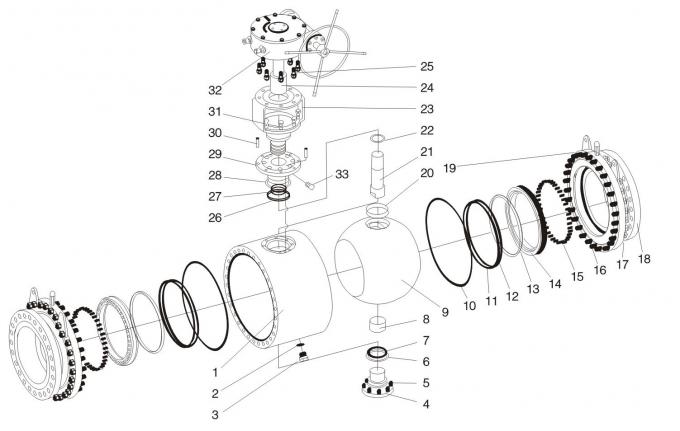
Swipe horizontally to see all materials
| No. | Part Name | Carbon Steel |
|---|---|---|
| 1 | Body | ASTM A105 |
| 2 | Gasket | Flexible graphite + SS |
| 3 | Drain valve | ASTM A105 |
| 4 | Bottom cover | ASTM A105 |
| 5 | Stud | ASTM A193 B7 |
| 6 | Gasket | Flexible graphite + SS |
| 7 | O-ring | Viton |
| 8 | Bottom bush bearing | PTFE + CS |
| 9 | Ball | ASTM A105 + ENP; F304; F316 |
| 10 | Middle flange gasket | Flexible graphite + SS |
| 11 | O-ring | Viton |
| 12 | Fire-safe ring | Flexible graphite |
| 13 | Sealing ring | PTFE / NYLON / PEEK / MOLON / PCTFE |
| 14 | Seat | ASTM A105 + ENP |
| 15 | Spring | Inconel |
| 16 | Stud | ASTM A193 B7 |
| 17 | Nut | ASTM A194 2H |
| 18 | Bonnet | ASTM A105 |
| 19 | Sealant injection valve | ASTM A105 |
| 20 | Top bush bearing | PTFE + CS |
| 21 | Stem | ASTM A182 F6a / F304 / F316 |
| 22 | Flat bush bearing | PTFE + CS |
| 23 | Yoke | ASTM A216 WCB |
| 24 | Connecting ring | ASTM A105 (confirm; original ANSI 1025) |
| 25 | Stud | ASTM A193 B7 |
| 26 | O-ring | Viton |
| 27 | O-ring | Viton |
| 28 | Gasket | Flexible graphite + SS |
| 29 | Back seat | ASTM A105 |
| 30 | Locating pin | ASTM A182 F6a |
| 31 | Stud | ASTM A193 B7 |
| 32 | Worm gear | — |
| 33 | Sealant injection valve | ASTM A105 |
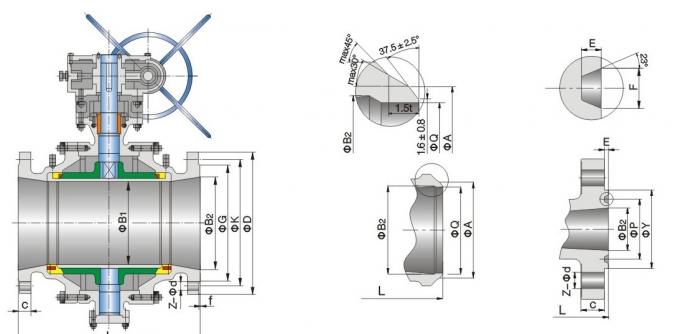
Swipe horizontally to see all dimensions
| Size (valve * bore) | DN | L | B1 | B2 | D | G | f | K | Z-Φd | c | Groove | A | |||||
|---|---|---|---|---|---|---|---|---|---|---|---|---|---|---|---|---|---|
| DN | RF | RTJ | BW | B1 | B2 | D | G | f | K | Z-Φd | c | Y | P | E | F | A | |
| 3*2 | 80*50 | 470 | 473 | 470 | 49 | 74 | 216 | 91.9 | 6.4 | 165.1 | 8-25.4 | 38.1 | 124 | 95.25 | 7.92 | 11.91 | 91 |
| 4*3 | 100*80 | 546 | 549 | 546 | 74 | 100 | 267 | 127 | 6.4 | 203.2 | 8-31.8 | 47.8 | 168 | 136.52 | 7.92 | 11.91 | 117 |
| 6*4 | 150*100 | 705 | 711 | 705 | 100 | 144 | 311 | 157.2 | 6.4 | 241.3 | 8-34.9 | 53.8 | 194 | 161.92 | 7.92 | 11.91 | 172 |
| 8*6 | 200*150 | 832 | 841 | 832 | 144 | 192 | 394 | 215.9 | 6.4 | 317.5 | 12-38.1 | 82.6 | 248 | 211.12 | 9.52 | 13.49 | 223 |
| 10*8 | 250*200 | 991 | 1000 | 991 | 192 | 239 | 483 | 269.7 | 6.4 | 393.7 | 12-44.5 | 91.9 | 318 | 269.88 | 11.13 | 16.66 | 278 |
| 12*10 | 300*250 | 1130 | 1146 | 1130 | 239 | 287 | 584 | 323.9 | 6.4 | 482.6 | 12-50.8 | 108 | 371 | 323.85 | 11.13 | 16.66 | 329 |
| 14*12 | 350*300 | 1257 | 1276 | 1257 | 287 | 315 | 673 | 381 | 6.4 | 571.5 | 16-54 | 124 | 438 | 381 | 14.27 | 23.01 | 362 |
| 16*14 | 400*350 | 1384 | 1407 | 1384 | 315 | 360 | 749 | 412.8 | 6.4 | 635 | 16-60.3 | 133.4 | 489 | 419.1 | 15.88 | 26.97 | 413 |
| 18*16 | 450*400 | 1537 | 1559 | 1537 | 360 | 406 | 826 | 469.9 | 6.4 | 704.9 | 16-66.7 | 146.1 | 546 | 469.9 | 17.48 | 30.18 | 464 |
| 20*18 | 500*450 | 1664 | 1686 | 1664 | 406 | 454 | 914 | 533.4 | 6.4 | 774.7 | 16-73 | 162.1 | 613 | 533.4 | 17.48 | 30.18 | 516 |
mm. Class 1500 reduced bore shown; sizes are valve size * bore size (e.g. 3*2 = 3" valve with 2" bore). Full bore and other classes on request.
What is reduced bore (RB) on this Class 1500 forged trunnion ball valve?
A reduced bore (RB) ball valve has a bore smaller than the pipe internal diameter, so the valve is more compact and economical than a full bore valve, at the cost of a higher pressure drop. In this Class 1500 A105 series, the reduced bore sizes are shown as 3*2, 4*3, 6*4, 8*6, 10*8, 12*10, 14*12, 16*14, 18*16 and 20*18, where the first number is the valve size and the second number is the bore size. Reduced bore is commonly used where the pressure drop is acceptable and space, weight or cost is a constraint; full bore is used where pigging or the lowest pressure drop is required.
What is the difference between this Class 1500 reduced bore valve and the forged trunnion Class 150–2500 series?
This page is the Class 1500 reduced bore version, with sizes from 2" to 20" shown as 3*2 to 20*18. The forged trunnion 3-piece series page covers Class 150, 300, 600, 900, 1500 and 2500, and includes both full bore and reduced bore options up to 36". The body, trim and seat options, fire-safe design and anti-static structure are the same; the difference is the pressure class coverage, the bore type and the size range. If you need full bore, other pressure classes, or sizes above 20", refer to the forged trunnion series page.
What is Class 1500 used for on a forged trunnion ball valve?
Class 1500 is a high-pressure ASME class, commonly used on wellhead, high-pressure pipeline, high-pressure process and high-pressure injection service. A forged body such as ASTM A105 is preferred at Class 1500 because the forging gives a dense, uniform grain structure and is less prone to casting defects under high stress. The pressure-temperature rating is to ASME B16.34. For sour service, NACE MR0175 compliance is available on request.
Is this A105 Class 1500 forged trunnion ball valve fire-safe and anti-static?
Yes. The valve is designed with a fire-safe structure to API 607 and JB/T 6899: if the soft seat ring is burnt in a fire, the fire-safe ring and metal-to-metal backup prevent mass leakage and limit fire spreading. An anti-static device is fitted to divert the electrostatic charge generated by ball-to-seat friction, so static sparks are avoided. A locking device is provided at the fully open and closed positions of the hand-operated valve. NACE MR0175 sour-service compliance is available on request.
Contact Person: Mr. Biff Teng
Tel: 86-18066318081


